You probably won’t be surprised to hear that I’m an early adopter. I like to try out new products and technology, and I’m used to products having some rough edges. But sometimes, the edges are so annoyingly rough that I just have to share my frustration. You, dear reader, are the lucky recipient.
About this time two years ago, I was at Target shopping for some new outdoor Christmas lights, and I saw some really cool looking blue LED icicle lights from Philips. They cost far more than the old fashioned kind of lights, but they looked neat and I’m a sucker for new products. Also, the box claimed that they offer “up to 88% energy savings” and “25,000 hour average bulb life,” so I figured they’d last a long time. I bought three sets, put them up, and I liked them so much that I bought another set last year.
This year when I tested them before hanging them (a crucial step), I discovered that three of the four sets were malfunctioning. Including the new set purchased just last year. On two sets, only half of the lights worked, and on the third, none worked at all. After some testing and inspection, I discovered what you see in the photo below.
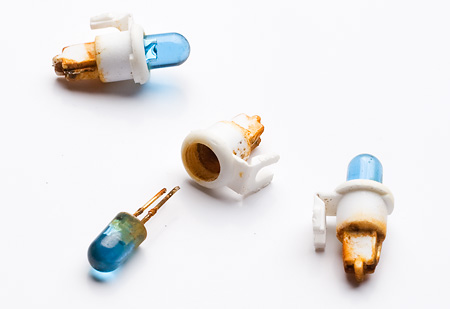
That’s right. Rust! Apparently, the wires on the LEDs are steel, so they rust when they get wet. Really great design for lights that are meant to be used outdoors, huh? All four strings have severe rusting. It’s worst on the lights at the bottom of the “icicles,” presumably because that’s where the water runs to when it rains. It turns out, this is a known problem. But it wasn’t known to me when I bought the lights, and it may very well not be known to you. Until now, of course. You’re welcome.
This year, I’ll be using good old incandescent Christmas lights outside.


We discovered the exact same problem with our LEDs. We bought them last year, used them less than 200 hours, stored them in a rubbermaid tote in a storage unit.
I was shocked to discover the icicle lights that we’d spent so much money on last year so we could get more years/usage out of were so badly damaged that I suspected they were a fire hazard and could put on my house.
We went and replaced them all with GE incandescents. Sometimes newer isn’t better, I suppose.
OH. and I wrote a SCATHING email/letter to Phillips and have had no response. At all.
Not surprising, really.
I’ve had the same experience with my LED’s from Philips. I purchased 5 strands last year and only used them for 30 days. I stored them in a plastic storage container in the attic. When I put them up I had 2 working strands and three that were half working. The parts that were half working had rusted lights and housings. I purchased another strand so I could use the old one as spare parts but the housings were rusted so it didn’t work. I called the manufacturer of the lights using a phone number on the bottom of the box. They told me they don’t guarantee the lights and they recommended that I contact Philips. I got the run-around at Philips and left a message with the specialty light department. I didn’t get a call back. I’m going to purchase more from Target and then return the rusted ones back to them and tell them that they are defective. I’m sure I won’t be the first.
I am checking out LED lighting- icicles and regular LED strands. I am considering using LED’s for a large shopping center. That would be a real horror story if I bought 340 strands of LED’s and they all rusted through. Thanks for the heads-up.
Thanks as well….I am a personal shopper and was about to buy a very large amount of blue icicle lights for a client. I’m going to have to change my “plan” for this house!
Mary, Costch and Sam’s Club have medium grade LED’s. These have bulbs that can pull out and be replaced. Since they can be removed, there is a higher chance that more water/moisture can enter and rust/corrode on the inside. If I were getting something for a residence and you aren’t leaving them up year round, then they shoulc be fine. If you work in Bel Aire or Beverly Hills, let me know and I will tell you were the shopping center is that I just completed using commercial grade LED sealed lighting strands.
Same as all the above. i got tired of replacing incadecent lights and filling land fills with them the next year. i spent about $500.00 so i wouldn’t have to through them away. pull them out this afternoon and thought “this will be great… i don’t have to screw around checking each strand”. I started putting them up assuming they all worked. fortunately i didn’t get too far. 1/5 of one strand worked, none of the next and 3/5 of the third strand. i seriously thought about buying new and returning to Target but it is not Target’s fault. Target’s corporate buyer needs to be made aware of it. That is my first call because i assume Phillips will have “no knowledge of a problem”. What a waste. i tried to be a good steward of mother earth… Phillips pulled their last one over on me.
Wow, I am so glad I found this websight before I spent $600.00 for new lights.
Thanks for the heads up and I’m sorry you didn’t know before you bought them too.
Not all LED christmas lights have this problem. You can buy strings that are completely sealed and won’t rust out. You can get them from places like ledholidaylighting.com. Also, some of the other brands like GE that do have replaceable bulbs have a coating on the LED wires now that helps to prevent rusting.
I have sealed bulbs that are all still working after 2 years. My 3 set of philips from 3 years ago are all pretty much rusted and useless. I’m not buying any more of the in-store LEDs. Definately look at the sealed strands!
I have the exact same problem, what a CRAP design!
This is the second year I have had to pull out the bulbs and scrape off rust, and try to salvage these things.
They were not cheap, and no way will I ever buy LED lights from Philips again (or any non sealed unit for that matter)
Me too. I just threw out one LED Icicle set (salvaged as many LEDs as I could for the remaining set). There is absolutely no reason that LEDs should need to be replaced. I would gladly tolerate an occasional defective LED if the string was sealed.
On a different note, one of the reasons I was attracted to LED lighting is the power savings. If you look at most LED strings there are big lumps in the wire occasionally. These are power resistors used to drop the voltage/current down to a level which the LEDs can tolerate. This is the *most* inefficient way to drop the voltage or to limit the current. There are a number of cheap regulator ICs and LED control chips which could do the job much more efficiently for a few pennys more. While it is true that even with the dropping resistors the LED lights are more efficient than incandescent, why not go all the way and really capitalize on the power savings???
For now, I will use incandescent outside and a mix inside.
I put my 2007 LED Philips lights up this weekend and have the same problem with the rust. Luckily only two strands out of 30 didn’t work and I bought 3 extra boxes last year. I am so disgusted after spending over $500 last year. I had hope to get at least five years out of the lights figuring I spent $17 a strand. Ijust wonder how can these possibly be rated for outdoor use? UL is on my list to call/write, along with Target, the Better Business Bureau and Philips. I bought the white and blue random twinkle and they aren’t even making them this year. I am hoping to get through the month. The LED’s do use less enegry as my electric bill was a 1/3 of what it normally would be. This probably could have been avoided if they used copper insteed of steel - another example of corporate greed.
Unfortunately, I found this site 3 years too late. Here is my experience and review posted on Amazon. These lights are total ripoff!
In need of lights I started buying these lights 2 years ago. You either like the look or don’t. I do.
Lo and Behold, this year (the third year), over half of my light strings did not work. After some investigation…many of the bulb filaments and sockets were RUSTED out! This makes replacing the bulb impossible. And if one bulb goes out, all the bulbs after it go out. Some advance in technology huh?
Now that I have so much invested I have to go out and buy new strings. Now Target/Philips have me locked into a pretty good profit cycle now.
I have to assume Philips did this on purpose. How can a light be outdoor use in rain and snow and be engineered to not rust. How in this day and age can you make lights that all go out after one burnt out bulb. It’s ludicrous to think they didn’t do this on purpose.
To add insult to injury these bulbs cost 5 times what regular strings cost AND they tout the money saved in energy. What complete BS. I don’t save any money if I have to replace strings every year at 5 times the prices.
I wish I could give these lights zero stars and had the energy to put this negative review on every Philips light set. What a bunch of cr*p!!!
I bought one string set this year that had smooth globes. It looks like they engineered a fix by making the socket, light and globe one piece and wrapping tape around the bottom of the socket. Nice try. But get this. On these strings the bulbs are not replaceable. So if your 2.5 year old steps on one…oops…out to buy a new set. Nice try Philips. So lame…
Well….I did a search wondering why a third of one of my 4 strings wasn’t out. After changing the fuses and I had to hit up google and quickly found my answer as soon as I hit this blog. I noticed some exterior rust when I pulled them out this year, but didn’t think anything of it. I figured that since I bought some of the best lights Target had, I’d be in business for at least a few years. It’s odd though that it seems to be effecting an end of a string for everyone (or the whole string), when it seems like that it should just effect individual bulbs (much like a burnt out one, won’t kill the whole strand).
I’m going to try to strip out each bulb and clean it down….I don’t want to have to pay another $17 for a box just to have the other ones start going out next year….eventually I’ll have to completely replace all the lights I guess, and it won’t be with Phillips.
Wow! I’m also glad I found this review. It has been exactly one year since the blog. There ought to be a class action lawsuit against Philips on these bulbs. Making consumers believe that their inferior LED lights will save you money is false advertising. I actually bought 3 sets of these LED icicle lights with cool white/blue conical (wide angle) bulbs from Target last week. They look so cool that I wanted to buy more only to find out the next week that they have sold out in two Targets that I’ve visited. I hope they do not come out crap like the Philips. Well for $10 each (10ft of 70 bulbs), they cost quite more than regular incandescent mini lights. Anyway, Target don’t sell them online. It’s some generic brand called EverStar which I never heard of and I couldn’t find it elsewhere.
http://images.amazon.com/images/P/B0019CK07Q.16._SCLZZZZZZZZ_.jpg
Also I didn’t see the Philips brand in the store but found this guy touting the twinkling version of his Philips blue LED icicle lights on YouTube. He wanted to buy more but he should be warned. I wanted that twinkling kind but I couldn’t find them anywhere. I don’t know what Target’s return policy is but it would be great if you can return them anytime the lights crap out on you. I hear Costco and Home Depot have excellent return policies.
http://www.youtube.com/watch?v=2-r0C100FhM
I bought five sets from a seller on ebay last year after christmas. I couldn’t find the soft white icicle lights locally. Three sets have been up for less than a week and one set already has a section out. I fully expected these lights to last me at least five years. I am so disappointed. I did notice these lights look like someone converted them and they came with replaceable bulbs. I should have known there would be issues and returned them right away. The other led strings I have are sealed and did not come with any replacement bulbs.
I believe the rain, wind and weather is just as rough on these as they are on other less expensive lights. I bought them for the energy savings (the money savings would have to be over the long haul with the costs difference in buying them to begin with). Mostly I bought these because I had exceeded my wattage on my outdoor plug and overloaded too often. I switched to led’s to be able to add to my lights and found them so much easier as you don’t have to worry so much about how many strands you connect together. I haven’t blown a fuse, timer or started any fires since switching to the led’s so it is worth it for that, but none-the-less annoying to have to deal with new, expensive lights that don’t work. Thanks for all the tips. I will look for only the sealed strands when I decide to bite the bullet and replace these.
Merry Christmas!
I also have problems with philips lights mine are regular icicle they are having the same problems.parts go out,some stay on. Nothing but junk cheaper lights work far better.
I found the last two boxes of blue/white icicle LED lights at OSH. Also Everstar brand. The wires are not sealed and it just rained here for days so I am afraid mine are gonna rust too. I will be returning the first ones I bought to Target and these ones to OSH afterwards. These horror stories makes me a bit nervous. Don’t want to use good money on crappy products.
I had the same problem with my Philips LED lights this year. 1/2 of one of the 60-strand went out and, upon closer inspection, multiple bulbs/sockets had rusted through. At $10 per strand, I was not very impressed.
I just got done returning mine to Target because of rust that I believe shorted the LEDs; as we have used all of the replacement LEDs that came with the set. I contacted Philips, yelled at a few people (’Tis the Season), only to find out that they do not manufacture these lights. A foreign company makes them, is imported, and Philips slaps their name on it. They don’t even offer any type of replacements or parts. They told me that I needed to simply take them back to Target because they could not do anything for me.
We bought the old-fashioned lights on Christmas Close-Out for $1 a pack for colored and $3 for icicles. It’ll take a few years to make up the difference in cost on my electric bill. After all, $15 is a lot to spend on lights that won’t even last a week outdoors.
Glad to see I am not crazy and that other people have had these problems too.
Thanks for the tips. Fortunately, I did not buy any yet.
For those who have already purchased sets, you may consider going to NAPA, Graybar, or WW Grainger to buy NO-OX (for No Oxygen) grease which is non-conductive and will prevent oxygen from getting onto the metal conductors and rusting. You will have to remove each bulb, coat the conductors with grease and re-insert them. I don’t know how these seats are made, but this may waterproof the connection too. Unfortunately, it may be messy, but it will save your investment and allow you to continue using them.